Is self-esteem worth all the hype? I met a foster parent a couple of years ago who didn’t think so. He told me about his woodworking shop, where he teaches kids to make things with their hands. He said something like: “We don’t believe in all that self-esteem stuff; when the kids make something they are proud of, they feel good about themselves.” He might not have believed in self-esteem, but his work was building it in the kids he worked with, one woodworking project at a time. Not everyone has a woodworking mentor to apprentice under; so what about the rest of us? So many self-help people claim we can fix how we feel about ourselves if we just listen to this podcast, or read one more article. How do we choose, and even after reading all the suggestions, how do we feel good about ourselves?
The self-esteem movement, which aims to make sure everyone feels seen and appreciated, has been closely followed by a countermovement that mocks “participation trophies.” In college I read “The Coddling of the American Mind” and it felt like waking up in the Matrix. Overnight I became aware of the consequences of valuing emotional safety more than the skills learned by being uncomfortable. I like many others also became enamored with grit after watching Angela Duckworth’s Ted Talk, emphasizing celebrating effort from kids instead of just outcomes. So when I met my future husband, I was impressed when he told me he commercially fished sockeye salmon in Bristol Bay, Alaska, every summer as a teenager, starting at 14. I was also nervous about the thought of him expecting me to one day send my own 14-year-old out on the high seas. When I asked his mom and dad how and why they did it, they said what is now one of my favorite quotes. “Life is hard enough. We wanted our kids to fight life, not us.” Putting their son on the same side with them, fighting life, waves, and fighting together instead of each other. They knew the experience and growth their son would acquire would outweigh the risks. Most folks I meet with agree with the premise of letting challenges build our self-esteem, however, I don’t thank many would be ok putting their 14 year old on a fishing boat. (And that’s ok.)
When I was dating my then-boyfriend, I went fishing with him, and it was one of the best and worst things I’ve ever done. Fishing is definitely a physical challenge, but even more so a mental challenge. When the fishing is 24/7, there is not much time to sleep between delivering one load of fish and setting the net for the next set. It was also undoubtedly the strongest I’ve ever been. Swaggering through the boatyard in my boots past the huge men’s bathroom to the 1-stall, 1-shower women’s bathroom, seeing my newly acquired “guns” in the mirror was a proud moment for me. The results of my work were all around me: brailers full of fish delivered to the tender, a clean deck after washing it down; an organized net locker after stripping and storing nets; and my increased upper-body strength.
A common theme in therapy is separating our self-worth from our accomplishments, but this doesn’t mean accomplishments don’t matter. We are wired to crave accomplishment: that feeling of crossing off a to-do list. When I have too much time on my hands, I chase that feeling of accomplishment in less lasting ways. I personally love farming simulation games; they are SO cozy and satisfying. I can get the dopamine of planting and harvesting a whole field of parsnips without ever leaving my couch or air conditioning, and in under an hour! Unfortunately this speed and convenience has a price. Having both our work and our play on computers can make life feel fake. (Big Think, 2026) I find that if I spend too much time with digital work, video games, or even online connection with friends, I need to reconnect with people face to face and tasks that require my hands. I recently worked up the courage to mess around in the actual dirt around my house, and I felt that same pride pushing a huge cart of mulch through Lowe’s that I did swaggering through the boatyard. Unlike my climate-controlled, pixel-perfect parsnips, it took longer than an hour; I was sweaty and messy afterward, and if you ask my family, they’ll tell you I’ve been grumpy and itchy for days from poison ivy. It was not as convenient as my climate-controlled parsnips, way more messy, itchy, and time-consuming. It was also way more satisfying. Despite the challenges, or maybe because of them, it felt incredibly good to get some dirt under my fingernails, just like it did to get some scales on my boots.
I am incredibly grateful for my time fishing in Alaska. Fortunately, I don’t have to get on an airplane to enjoy the satisfaction of getting my hands dirty, and I’m not recommending commercial fishing as the cure-all for self-esteem. Our culture is full of “you deserve it” messaging, often saying you deserve a break, to make your life easier, or to spend more money on yourself. Two things can be true: you deserve a break, and you also deserve a challenge. You deserve to see yourself get better at something. Humans need mastery, alongside autonomy and purpose to be motivated (Pink). Being able to see, feel, or even taste our progress is satisfying in a way that digital parsnips can’t be. I’m still going to tend my digital garden; I get to relax in my own nerdy fashion. I’m still going to give myself breaks and little treats. But I’m not going to pretend that treat-yourself culture is the cure-all for self-esteem for myself or my clients. To feel better, we need human connection, self-compassion, and to do hard things that challenge us. Whether what challenges you is prioritizing yourself or pushing yourself, now is the time to give yourself both the break and the challenge you deserve. What is something you have been putting off doing because it feels too hard? How do you think you might feel after you do it?
How much of your worth comes from your accomplishments? Do you need to change the balance between your digital and physical work? What could give you the courage to start?
Stay curious,
Laura Danese
PS. If she could do it, you can do it. 🙂
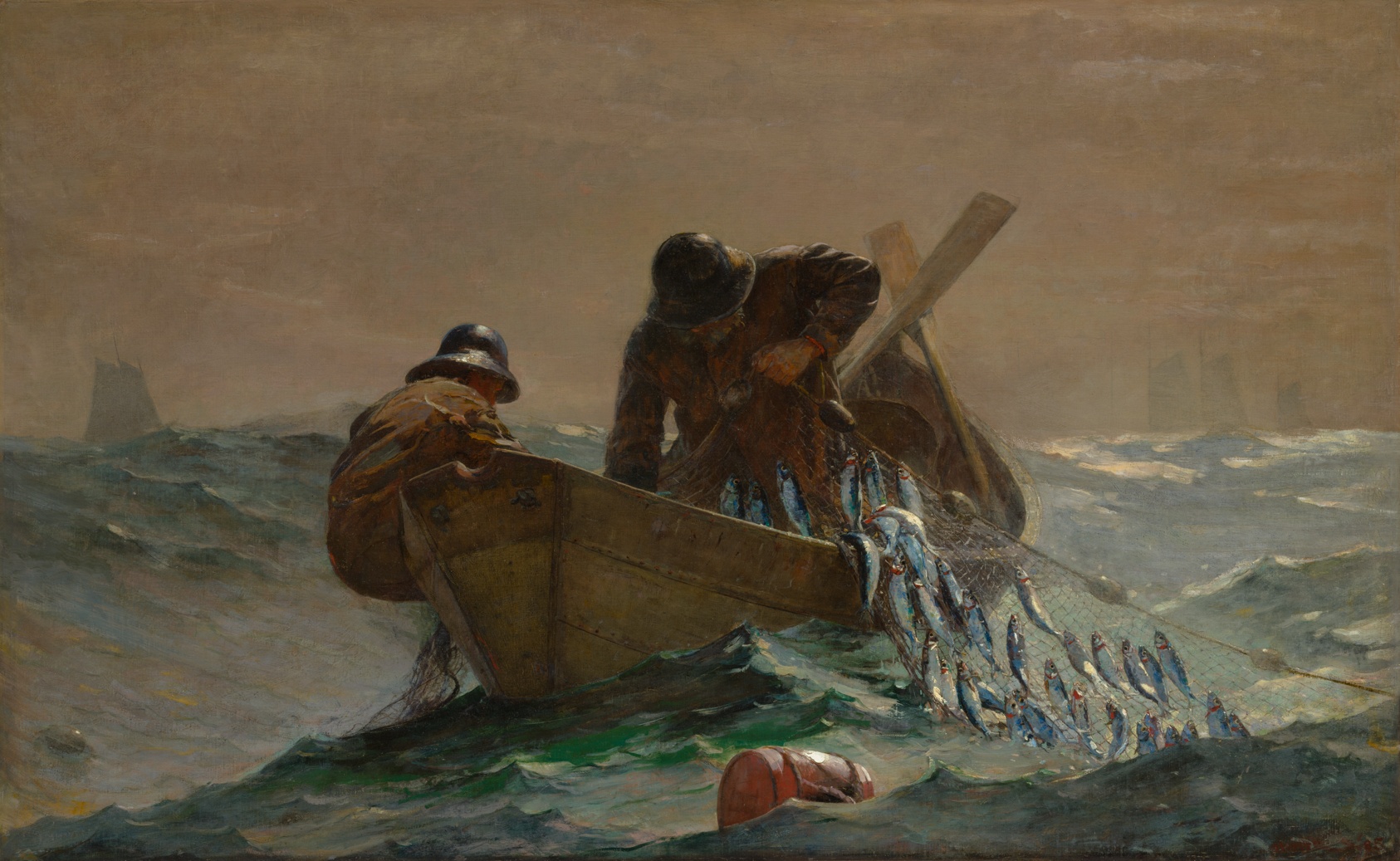
Photo Credits: Homer, Winslow. The Herring Net. 1885. Art Institute of Chicago
Big Think. (2026, August 7). Depression has tripled in the last 15 years. Arthur Brooks says he knows the real cause [Video]. YouTube.
Duckworth, A. L. (2013, April). Grit: The power of passion and perseverance [Video]. TED Conferences. TED Talk
Greg Lukianoff; Jonathan Haidt (2018). The Coddling of the American Mind: How Good Intentions and Bad Ideas Are Setting Up a Generation for Failure. Penguin Publishing Group. ISBN 978-0-7352-2489-6.
Pink, Daniel H. Drive: (2009) The Surprising Truth About What Motivates Us. Riverhead Books, New York, New York
Leave a Reply